
Human & Business
Identity & Entities (Tab 1)
File Identity
Metadata & Codes (Tab 2)
4 Wallets, 2 Paths
The Money Flow (Tab 3)
Post Ops & Legal
Final Touches (Tab 4 & 7)

Music Business 2.0
"No matter what the game, if you don't know the rules, the game will play YOU."
Welcome to Music Quest. We are not attorneys. This school is based on real-world experience, not legal theory. Any legal decisions you make should be consulted with a qualified attorney in your state of residence.
Tab 1 - Human + Business Identity
I. Learn (Pre-Release) - Understand Each Player
I used to think of record labels as these giant, mythical palaces where only "big shots" got to hang out. I thought you had to be discovered by some all-powerful music executive to even get an invite.
What I didn't get is that a record label isn't necessarily a building-it's the business framework of the industry. Learning the players in that framework is the first boss battle on your quest.
1. What is a Record Label?In simple terms, a record label is the business entity that handles all the stuff artists hate: distributing the music, protecting the copyrights for the sound recordings, collecting the royalties for those recordings, and managing the metadata. A label's job is focused on the master recording-the final product you hear on streaming services. Aren't you doing that anyway?
2. What is a Publisher?A music publisher, is often times also the record label. Think of a publisher as a sort of middle man or promoter for the song. They manage and protect the copyright of the song and are responsible for collecting all the royalties associated with the composition. This business can also be an LLC or a sole proprietorship. What are those? I got you in the next chapter.
3. Tying It All Together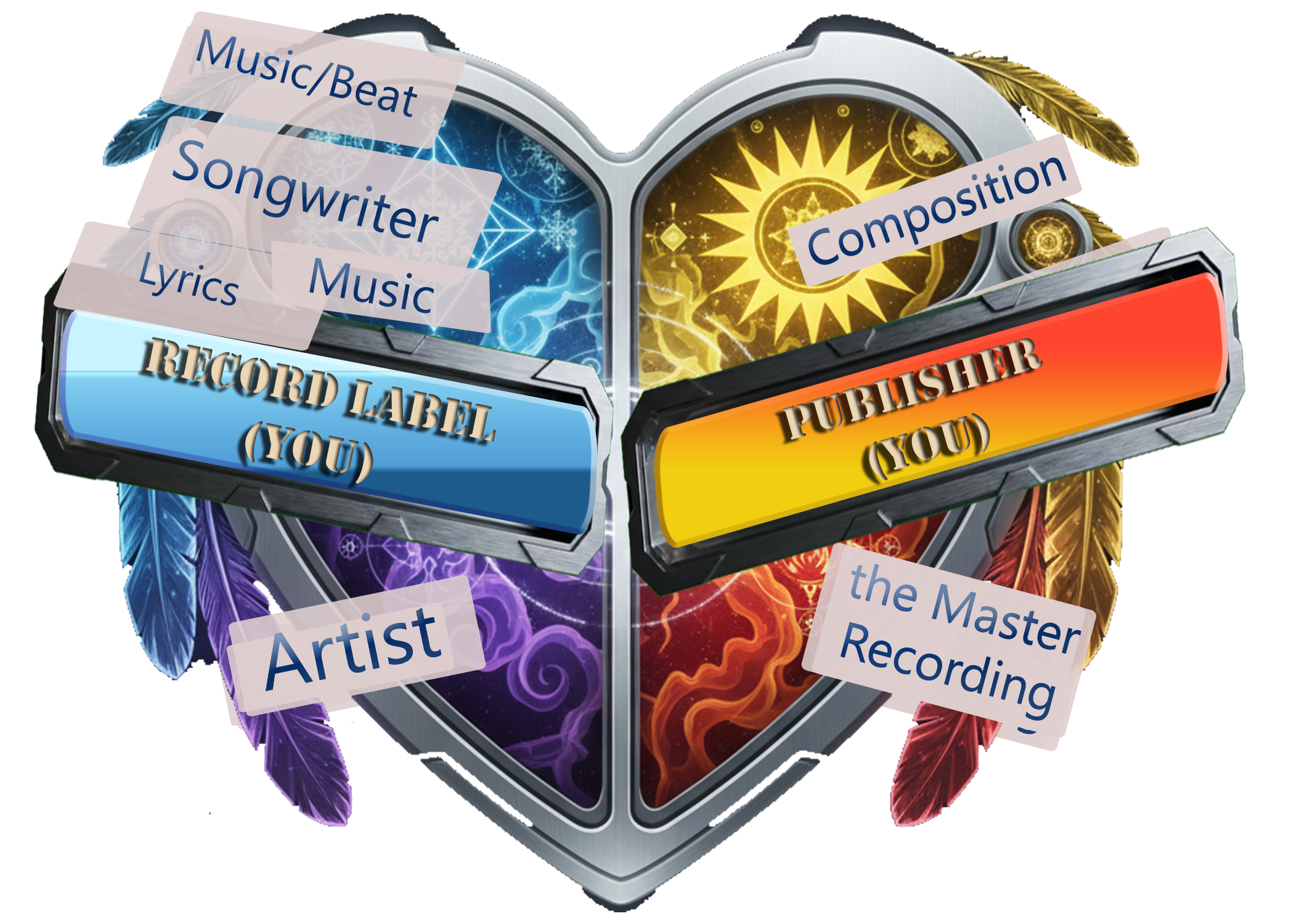
The Most Important Secret in the Music Industry:
The industry wants you to think you are only an "Artist" or "Songwriter." They do this so you'll sign a contract with a "Label" or a "Publisher" who will "help" you.
This is the redirect.
You, the independent creator, are BOTH the Publisher AND the Label. The "thieves" of the industry are almost always "publishing companies" (often run by a "trusted friend") who offer "help" in exchange for you signing over your "Publisher's share" of the Composition (). This is the single most valuable asset a creator has, and they trick you into giving it away.
Never give up your Publisher's share. If you remember nothing else, remember this.
II. Learn the Royalty basics.
Objective: Understand the two halves of your song.
1. Understanding that every song in the world has two (2) copyrights (legal souls):
- The Composition (©): This is the song itself-the melody, lyrics, and structure. This is the property of the Songwriter and their Publisher.
- The Master Recording (℗): This is the specific audio file of that song-the "master" copy. This is the property of the Artist and their Label.
This system is designed this way for a reason. Whether you sign with a major label or decide to build your own, you have to operate within that framework.
II. Learning and Choosing Your Business Structure
Your business structure is the legal shield that separates your creative career from your personal life.
First, a secret: to be a record label, you don't need a building or a team of executives. You simply need to declare yourself a record label and establish legal framework.
Let's look at the two most common options.
Option 1: Sole Proprietorship/DBA (The Simple Start)Think of a sole proprietorship as the most basic business structure there is. The business is simply an extension of you. "DBA" means "Doing Business As"
- The Action: You don't have to do anything to be a sole proprietor at all. You are automatically a sole proprietor. You may need to file a "doing-business-as" (DBA) certificate if you use a business name other than your own legal name, like Super Funky Tron with the State you live in.
- The Why: The biggest benefit is simplicity. There are no startup costs. All your business income and expenses are reported on your personal tax return, which can make tax season easier.
- The Caveat: The major drawback is unlimited personal liability. There is no legal separation between you and your business. If your business is sued or goes into debt, your personal assets are at risk.
An LLC is a separate legal entity from you, the owner. It's a more formal structure that provides a crucial layer of protection.
- The Action: To form an LLC, you must file official paperwork (usually called Articles of Organization) with your state. After that, you need to get a separate business bank account and an Employer Identification Number (EIN) from the IRS. You must keep your personal and business finances completely separate.
- The Why: The biggest benefit is limited liability protection. If your business is sued or racks up debt, your personal assets are protected. This is a game-changer. It also gives you more credibility in the industry and a clearer way to manage your business expenses.
- The Caveat: It costs money to set up an LLC (fees vary by state), and there are often continuous taxes and fees. In many states, once you start the LLC, you are legally bound to continue paying taxes or be forced to shut down. Please research your state and options.
III. Establish Yourself As a Player (Pre-Release)
Purpose: Establish the necessary entities to protect your work, track your music, and begin the process of collecting all types of royalties.
Your Identity
Your IDs (IPIs & Account Numbers)
+50 Artist XP
Tab 2 - File Identity
I. Song/Release-Specific Identifiers & Registrations
Purpose: Obtain unique codes for each track/release and formally register the intellectual property with relevant rights organizations.
Song Metadata Entry
Royalty Split Sheet
Define ownership for this song. Total must equal 100%.
My Catalog
No songs saved yet.
II. Metadata Tagging & Distribution
Purpose: Ensure precise metadata is embedded into your audio files for accurate royalty collection and seamless delivery to digital platforms.
Embed all collected metadata directly into your WAV or FLAC audio file. Use software like Mp3tag, MusicBrainz Picard, TagScanner, or Kid3.
Thoroughly review all tagged information for spelling, accuracy, completeness.
Complete the upload process. Ensure all metadata fields match the embedded tags.
+50 Artist XP
Tab 3 - 4 Wallets, 2 Paths
I. The DTC "Owning" Path
Objective: Understand how the DTC path bypasses the complicated "Renting" maze. This is why we focused on the DTC "Owning" Path first.
When you sell your music directly to a fan (DTC):
- The fan is buying a copy for their Private Performance (like "buying shoes").
- Because it is a private performance, the messy "Public Performance" royalty (the main fee for "renting") doesn't apply.
- Because it is a sale and not a "digital radio" broadcast, the "Digital Radio" royalty is also bypassed.
- The "sale" of the Sound Recording () is paid to you (the Label) directly.
- And the "sale" of the Composition ()? That also gets paid... to YOU.
There is one rule from the "Renting" path that legally applies to a DTC "sale": the Mechanical Royalty. Because a "sale" is a "reproduction" (a "copy") of the Composition (), a mechanical royalty is legally owed.
This means the entire, complicated maze is replaced by: One single, transparent payment: Fan -> You. (And a legal, transparent royalty payment: MLC -> You).
II. The "Renting" Path Deep Dive (The Four Wallets)
Objective: Understand the "Renting" path and who collects the money.
When you "rent" your music, that platform has to pay two main bills:
- A bill for using the Song/Composition ()
- A bill for using the Master Recording ()
But these bills aren't simple. The money gets split and goes to four different "wallets".
Part 1: Following the Money for the Composition ()This is the money earned by the Songwriter and Publisher.
- Wallet 1: The "Radio" Wallet (Your PRO)
Who: PROs (ASCAP, BMI, SESAC). What: Public Performance royalties. Where from: Radio/TV, bars, live venues, non-interactive streaming. Who they pay: Split 50/50 between Songwriter and Publisher. - Wallet 2: The "On-Demand" Wallet (The MLC)
Who: The MLC. What: Mechanical royalties. Where from: Interactive "on-demand" streaming and digital downloads. Who they pay: 100% to the Publisher.
This is the money earned by the Artist and the Label.
- Wallet 3: The "On-Demand" Wallet (Your Distributor)
Who: Your Distributor (DistroKid, CarToon Core, etc.)
Key Detail (The Aggregator Trap): To get on platforms like Spoti-lie, artists are forced to use one of these distributors. But the secret the industry hides is that most of these "competing" distributors aren't competitors at all. They are just different front-doors that all lead to the same few back-end aggregators. The market is dominated by a few giants like:
1. The Orchard (Owned by Sony Music Entertainment)
Key Subsidiaries & Acquisitions:
- AWAL: (Acquired from Kobalt in 2021)
- Red Essential
- IODA: (Merged in 2012)
- Iris Distribution
- Blind Dive Records
- Sandbag
- AutoKratz
Key Label Partnerships: Metal Blade Records, Pure Noise Records, Sarm Music, Cooking Vinyl, Fat Possum Records, Thirty Tigers.
2. Believe (which, owns CarToon Core)
Key Subsidiaries (Owned Companies):
- TuneCore: (Acquired in 2015)
- Groove Attack
- Nuclear Blast: (Believe owns a majority stake)
- Naïve
- AllPoints
- Sentric Music Group
- Canvasback
- Play Two
- Jo&Co
- Morning Glory Music
3. Ingrooves (owned by Universal)
Integrated Under Virgin Music Group:
- Virgin Music Label & Artist Services
- Ingrooves Music Group
- mtheory
Key Acquisitions & Technology: Sovereign, Fontana Distribution.
Note on "Ownership": Serves distribution for Dirty Hit, Roc Nation, Hyperdub, Text Records.
While there are rare exceptions, this means that whether you pick Distributor A, B or C, your money is often passing through another middleman (the aggregator) who takes a cut before you ever see a penny. - Wallet 4: The "Digital Radio" Wallet (SoundExchange)
Who: SoundExchange. What: Digital Public Performance royalties. Where from: Non-interactive "radio-style" digital streaming. Who they pay: Split between Label (50%), Artist (45%), and musicians (5%).
+50 Artist XP
Tab 4 - Post Ops & Final Touches
IV. Post-Distribution Royalty & Chart Registrations
Purpose: Maximize royalty collection after distribution and ensure your music is tracked for industry charts and awards.
Confirm the link between the composition and its digital streams.
Register each sound recording using its ISRC(s).
Ensure lyrics are properly associated with your song.
Register Artist, Song Title, and Album Title with Luminate Data. Submit music to Mediabase.
Submit for consideration during the awards cycle.
V. Legal & Long-Term Considerations (Tab 7)
Purpose: To secure comprehensive legal protection and explore additional royalty collection avenues.
Formally submit your musical work and sound recording. Provides statutory damages and ability to file lawsuit.
Harry Fox Agency (HFA), Music Reports Inc. (MRI), Neighboring Rights Societies (Outside US).
METADATA IS KING: Ensure all information is consistent and accurate across all platforms and registrations. This is the single most important factor for ensuring you get paid.
+100 Artist XP (Quest Complete)
Your Quest is Complete.
You know the rules. Now play the game.