
CREATOR HELM
School is Free. App is $3.
Disclaimer: This school is based on real-world experience, not legal theory. We are not attorneys. Any legal decisions you make should be consulted with a qualified attorney in your state of residence.
School is Free. App is $3.
Disclaimer: This school is based on real-world experience, not legal theory. We are not attorneys. Any legal decisions you make should be consulted with a qualified attorney in your state of residence.
Disclaimer: This school is based on real-world experience, not legal theory. We are not attorneys. Any legal decisions you make should be consulted with a qualified attorney.
Disclaimer: This school is based on real-world experience, not legal theory. We are not attorneys. Any legal decisions you make should be consulted with a qualified attorney.
Sovereign Data: Save this file to backup your work.
"No matter what the game, if you don't know the rules, the game will play YOU."
I. Learn (Pre-Release) - Understand Each Player
I used to think of record labels as these giant, mythical palaces where only "big shots" got to hang out. I thought you had to be discovered by some all-powerful music executive to even get an invite.
What I didn't get is that a record label isn't necessarily a building—it's the business framework of the industry. Learning the players in that framework is the first boss battle on your quest.
In simple terms, a record label is the business entity that handles all the stuff artists hate: distributing the music, protecting the copyrights for the sound recordings, collecting the royalties for those recordings, and managing the metadata. A label's job is focused on the master recording—the final product you hear on streaming services. Aren't you doing that anyway?
A music publisher is often times also the record label. Think of a publisher as a sort of middle man or promoter for the song. They manage and protect the copyright of the song and are responsible for collecting all the royalties associated with the composition. This business can also be an LLC or a sole proprietorship. What are those? I got you in the next chapter.
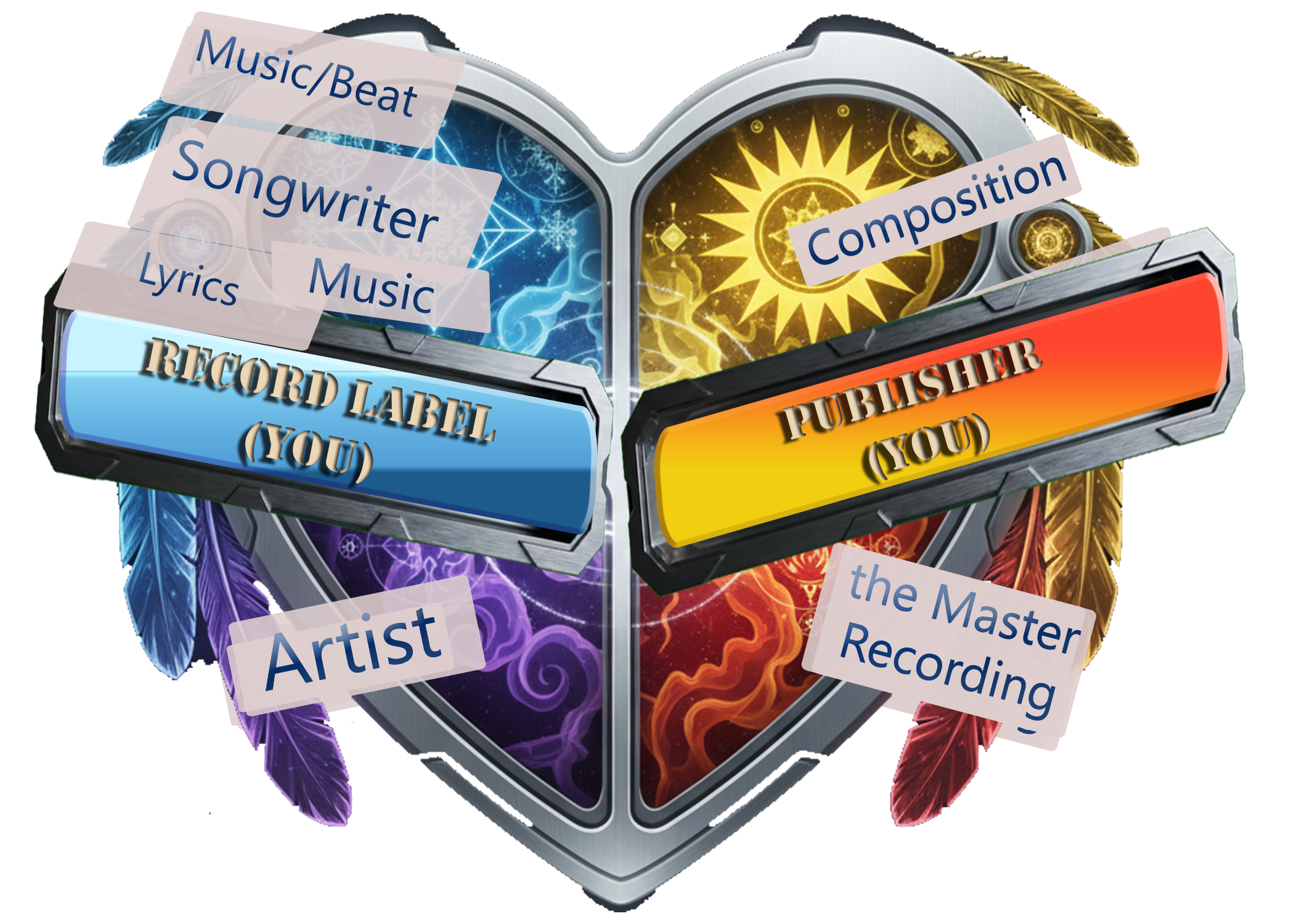
The industry wants you to think you are only an "Artist" or "Songwriter." They do this so you'll sign a contract with a "Label" or a "Publisher" who will "help" you. This is the redirect.
You, the independent creator, are BOTH the Publisher AND the Label. The "thieves" of the industry are almost always "publishing companies" (often run by a "trusted friend") who offer "help" in exchange for you signing over your "Publisher's share" of the Composition. This is the single most valuable asset a creator has, and they trick you into giving it away.
Understanding that every song in the world has two (2) copyrights (legal souls):
This system is designed this way for a reason. Whether you sign with a major label or decide to build your own, you have to operate within that framework.
Your business structure is the legal shield that separates your creative career from your personal life.
First, a secret: to be a record label, you don't need a building or a team of executives. You simply need to declare yourself a record label and establish legal framework.
Think of a sole proprietorship as the most basic business structure there is. The business is simply an extension of you. "DBA" means "Doing Business As"
An LLC is a separate legal entity from you, the owner.
For me, the choice was clear, but not by preference. The limited liability protection of an LLC was always the goal, but to be honest, I was broke and couldn't afford the fees. The only realistic choice I had was to start as a sole proprietorship.
Purpose: Establish the necessary entities to protect your work, track your music, and begin the process of collecting all types of royalties.
Song/Release-Specific Identifiers & Metadata
Purpose: Missing or incorrect metadata is a leading cause of lost royalties. Accurate metadata is critical.
Action: Embed all collected metadata directly into your WAV or FLAC file. This includes:
Free Software for Tagging: Mp3tag (Windows), MusicBrainz Picard (Cross-platform), TagScanner (Windows), Kid3 (Cross-platform).
Thoroughly review all tagged information for accuracy before uploading.
Objective: Understand the two main highways for your music—Private vs. Public.
What it is: The "Owning" model is the Direct-to-Consumer route. This path focuses on selling a copy of your music (digital downloads or physical goods) directly to your fans.
Analogy: This is like buying a pair of shoes. Your fan owns them. They can wear them whenever they want, in private. You get paid directly and fairly for your product.
What it is: This "Renting Model" is the traditional route of using a distributor to get your music onto public platforms like Pandora, Apple Music, YouTube Music, etc. These platforms are all forms of Public Performance. Listeners pay for temporary access.
Analogy: This is like renting shoes at a bowling alley. You pay for access, and the owner (the alley) gets paid for the public use. The owner of the bowling alley is then supposed to pay a royalty to the shoe manufacturer.
Even on this simple "Owning" path, there is one rule that good business follows. Because a "sale" is a legal "copy" of the composition, a Mechanical Royalty is owed to the Publisher. In a truly transparent model (like CreatorHelm/AmpWall), the storefront handles this by reporting the sale to The MLC, who then pays that royalty to... you, the Publisher.
When you "rent" your music (streaming), the money gets split into four different "wallets" depending on how it was played.
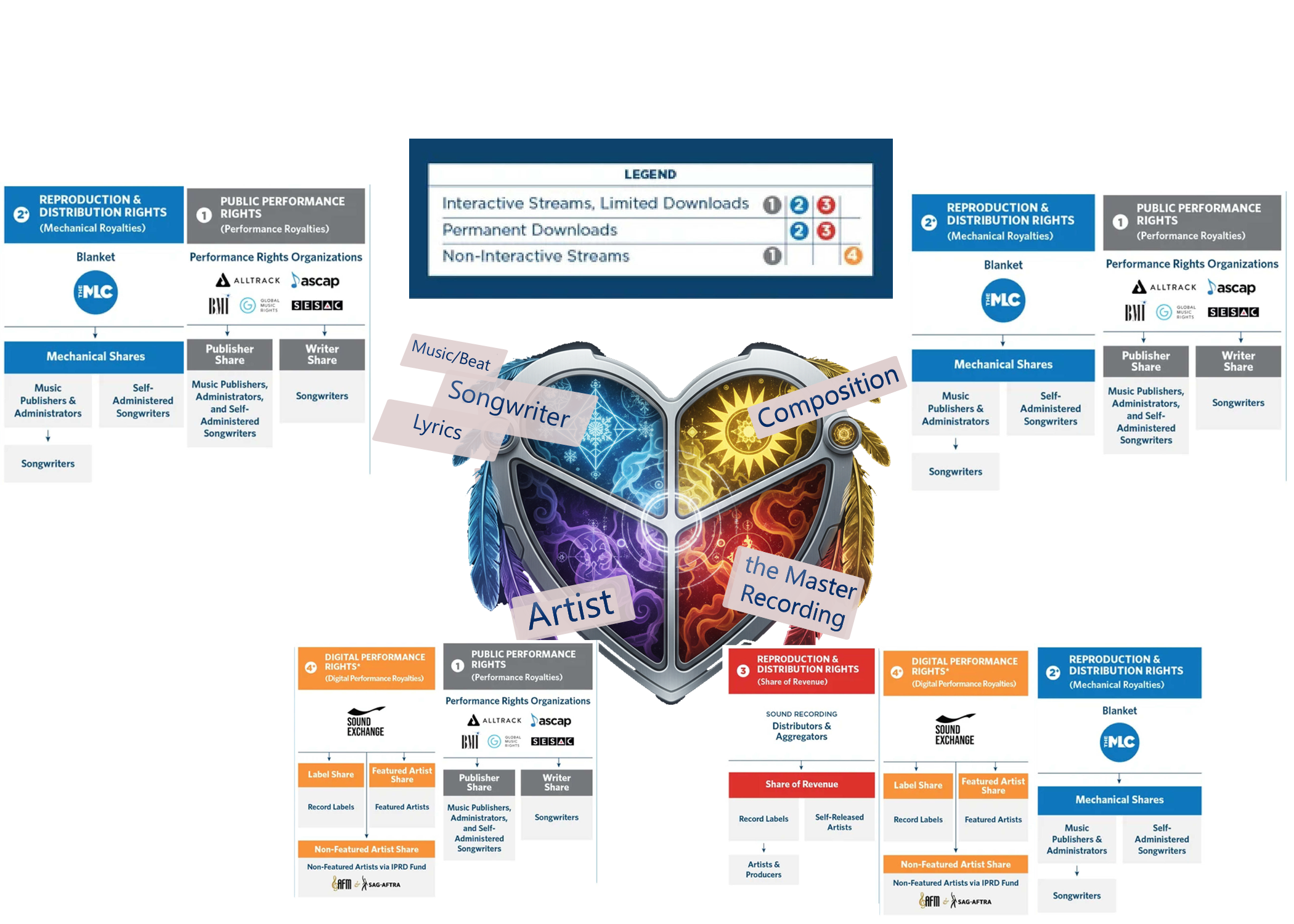
Who: PROs (ASCAP, BMI, SESAC, etc.)
What they do: Collect Public Performance royalties.
Who they pay: They split this money 50/50 between the Songwriter and the Publisher.
Who: The MLC (Mechanical Licensing Collective)
What they do: Collect Mechanical royalties (copies/streams).
Who they pay: They pay 100% of this money to the Publisher.
Who: Your Distributor (Distrokid, CarToon Core, etc.)
Who they pay: They pay you (as the Artist/Label) whatever is left.
Key Detail: The Aggregator TrapTo get on platforms like Spoti-lie, artists are forced to use one of these distributors. But the secret the industry hides is that most of these "competing" distributors aren't competitors at all. They are just different front-doors that all lead to the same few back-end aggregators. The market is dominated by a few giants like:
While there are rare exceptions, this means that whether you pick Distributor A, B or C, your money often passes through another middleman (the aggregator) who takes a cut before you ever see a penny.
Who: SoundExchange
What they do: Collect Digital Public Performance royalties for the master recording.
Where from: Non-interactive "radio-style" digital streaming (Pandora, SiriusXM).
Who they pay: They split this money between the Label (50%), the main Artist (45%), and session musicians (5%).
Purpose: Maximize royalty collection after distribution and ensure your music is tracked.
Confirm the link between the composition and its digital streams.
Register each sound recording using its ISRC(s).
Ensure lyrics are synchronized and displayed on streaming platforms. Link: MusixMatch Pro
To provide critical legal protection for your intellectual property (both the musical composition and the sound recording). www.copyright.gov
Disclaimer: This school is based on real-world experience, not legal theory. We are not attorneys. Any legal decisions you make should be consulted with a qualified attorney in your state of residence.